Persistent bunion pain can limit mobility, alter the way you walk, and make everyday footwear feel impossible. When the deformity progresses, patients from our Family Footcare CT clinics at Danbury, Naugatuck, and Southbury often describe increased swelling, stiffness, and discomfort that affects work, exercise, and long-term joint health.
Research in podiatric and orthopedic literature consistently shows that advanced bunion deformities rarely improve without structural correction, and early intervention can help protect overall foot function. Our CT foot and ankle surgeons use evidence-based approaches to reduce pain, realign the toe, and restore a stable gait pattern.

DPM, FACFAS, FACFO
Over 30 years of experience in bunion surgery, medical education, and clinical leadership

DPM
More than a decade of caring for patients across Connecticut as a board-certified podiatric surgeon.

DPM
Up-to-date surgical training with a conservative-first approach, guided by current research

DPM
An exercise science specialist who combines advanced surgical training with genuine empathy
What Is Bunion Surgery?
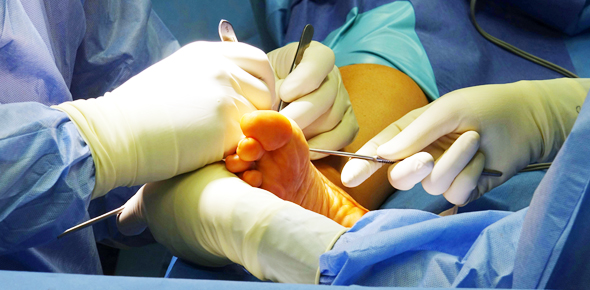
According to AAOS, Bunion surgery—often referred to as a bunionectomy, hallux valgus correction, or by specific technique (e.g., Chevron, Scarf, Lapidus)—is a procedure designed to correct the bony prominence and joint misalignment at the base of the big toe. According to orthopedic guidelines, bunions develop due to gradual misalignment of the first metatarsal and big toe, often influenced by genetics, ligament laxity, and mechanical loading patterns. Surgery focuses on restoring proper alignment, relieving pressure, and improving joint stability so you can return to comfortable, confident movement.
When Bunion Surgery May Be Recommended
Surgery is considered when structural deformity or symptoms persist despite footwear changes, orthotics, and activity modification. Many cases progress over time, and our specialists evaluate your foot using digital X-rays, clinical examination, and biomechanical assessment.
Severe Pain That Limits Daily Activities
When bunion pain interferes with walking, standing, exercise, or wearing normal shoes, surgery may provide lasting relief. Dr. James M. DeJesus, DPM, FACFAS, notes that when pain becomes mechanical—triggered by joint malalignment—non-surgical measures often give only temporary relief.
Progressive Toe Deformity or Joint Drift
If the bunion continues to worsen, causing the big toe to angle toward or cross over the second toe, surgical correction is often recommended to prevent further damage and difficulty walking.
Chronic Inflammation or Swelling
Persistent swelling around the metatarsophalangeal joint can indicate joint irritation or structural pressure that conservative care cannot fully resolve.
Difficulty Finding Comfortable Footwear
When even wide or supportive shoes cause pressure, friction, or pain, surgery may help restore a foot shape compatible with normal footwear.
Arthritis in the Big Toe Joint
Joint degeneration is common in long-standing bunions. Some patients benefit from realignment procedures, while others may require joint-sparing or joint-fusion options depending on arthritis severity.
Failure of Conservative Care
If orthotics, physical therapy, and footwear changes have not improved symptoms, structural correction may be the most effective next step.
How Bunion Surgery Works
Bunion surgery is tailored to the individual, based on X-ray findings, joint health, deformity severity, and your activity goals. Our surgeons focus on techniques that prioritize stability, alignment, and long-term function.
Bunionectomy (Removal of the Bony Prominence)
This approach removes the enlarged bone at the side of the big toe joint. It is typically combined with realignment techniques to prevent recurrence.
Osteotomy (Bone Realignment Technique)
Procedures such as Chevron, Scarf, or Akin osteotomies involve precisely cutting and repositioning bones to correct alignment. These procedures are supported by strong clinical evidence for long-term correction in mild to moderate deformities.
Lapidus Procedure (First Tarsometatarsal Fusion)
For patients with hypermobility or severe deformity, the Lapidus technique stabilizes the joint at the base of the first metatarsal. According to foot and ankle literature, this method reduces recurrence risk in high-instability cases.
Soft Tissue Balancing
Surgeons may adjust tendons, ligaments, or joint capsules to improve alignment and reduce strain on the big toe joint.
Joint Fusion or Replacement
For patients with advanced arthritis, options may include arthrodesis (fusion) or, less commonly, joint replacement to relieve pain and restore stability.
Your Plan for an Active Life
1. Schedule an Expert Evaluation Built Around You
We examine the structure of your foot, your gait mechanics, X-ray findings, and your symptoms to understand the root cause—not just the bump on the side of the toe. Your doctor will explain which type of bunion surgery best fits your goals.
2. A Clear, Personalized Treatment Plan
Whether you need a minimally invasive bunionectomy, an osteotomy, or a Lapidus fusion, your surgeon will walk you through the reasoning behind the recommendation and what outcomes you can expect.
3. A Roadmap Back to Comfortable Movement
Recovery includes guided weight-bearing progression, protection of the surgical site, and rehabilitation to restore mobility and strength. We make sure you know every step before surgery begins.
What podiatric surgeon choose to perform a bunion surgery?
Patients choose Family FootCare because we combine advanced training, evidence-based decision-making, and a patient-centered approach that makes each person feel understood and supported. Our doctors—Dr. James M. DeJesus, DPM, FACFAS, FACFO; Dr. Betty M. Carreira, DPM; and Dr. Austin Davidow, DPM—bring extensive experience in forefoot reconstruction and use modern diagnostic tools to ensure precise evaluation. We don’t rush decisions: every patient receives a thorough explanation of findings, treatment options, and realistic expectations so they can make informed, confident choices about their care.
What Happens If a Bunion Goes Untreated?
Untreated bunions often progress, and research shows the deformity may worsen even in supportive footwear.
- Increasing Pain Over Time: The joint becomes more inflamed, making walking and exercise increasingly difficult.
- Worsening Toe Misalignment: The big toe may press into or over the second toe, creating additional deformities such as hammer toes.
- Joint Damage and Arthritis: Chronic joint misalignment can lead to cartilage wear and arthritis in the first MTP joint.
- Skin and Soft Tissue Problems: Corns, calluses, and pressure sores may form due to abnormal loading.
- Reduced Mobility: Stiffness and limited push-off strength can change gait mechanics, sometimes leading to knee or hip discomfort.
Related Conditions and Treatments
- Hammertoes: Often linked with long-standing bunions due to altered toe pressure.
- Arthritis of the Big Toe (Hallux Rigidus): Some bunion cases progress to joint degeneration requiring specialized treatment.
- Flat Feet (Pes Planus): Flat arches can contribute to bunion formation by altering foot mechanics.
- Digital X-Ray Imaging: Essential for precise preoperative planning.
- Sports Injury Care: For patients whose bunion pain interferes with athletic activities.
We provide a full spectrum of treatments tailored to the diverse lifestyles of Southbury, Danbury and Naugatuck, CT, residents.
Schedule Your Appointment Today
If bunion pain is limiting your life, you don’t have to keep pushing through it. Our team will help you understand the cause of your symptoms and whether surgical correction may offer long-term relief. Schedule a consultation to begin your path toward comfortable, confident movement.
Whether you need a routine diabetic foot check, orthotics for work, or treatment for an injury, Family Footcare CT is here to help. Contact us!
Call us today to book your visit:
📞 +1 203-405-6501
Frequently Asked Questions (FAQ) about Bunion Surgery
While conservative care helps, surgery is the only way to correct the deformity. Dr. James M. DeJesus, DPM, FACFAS, evaluates the severity of the drift in the big toe (hallux valgus) at our Danbury clinic to determine if a realignment osteotomy or soft tissue repair is best.
Look for board certification and fellowship training. Our team, including Dr. Austin Davidow, specializes in keeping athletes active. We tailor bunion correction to ensure you can return to running and sports without losing push-off power.
Online orthotics are generic. While they may provide a temporary cushion, they cannot correct the biomechanical root of a bunion. At our Southbury location, we craft custom insoles made locally that specifically address your foot structure to slow bunion progression.
We utilize modern, minimally invasive techniques whenever possible. This involves smaller incisions and less soft tissue disruption, leading to faster recovery. Dr. Betty M. Carreira can explain if you are a candidate for these advanced procedures during a consultation.
Yes. Gout often attacks the big toe joint, causing sudden, intense pain that mimics a bunion flare-up. We perform fluid analysis in Naugatuck to differentiate between a structural bunion and metabolic gout.
Recurrence is rare with modern surgical techniques that address the 3D deformity of the bone. Dr. Michelle DeJesus follows AOFAS guidelines to ensure the correction is permanent by addressing the root cause, not just shaving the “bump.”
Bone healing typically takes 6 to 8 weeks. However, many patients can walk in a surgical boot within days, depending on the procedure.
Yes. As the big toe deviates, it transfers pressure to the smaller toes, potentially causing stress fractures or transfer metatarsalgia (pain in the ball of the foot).
This is a 3D bunion correction procedure that secures the unstable joint foundation. Dr. Austin Davidow is experienced in these rotational corrections to restore natural anatomy.
Once fully healed, most patients can wear a variety of shoes. However, we recommend avoiding excessive heel height to prevent future issues.