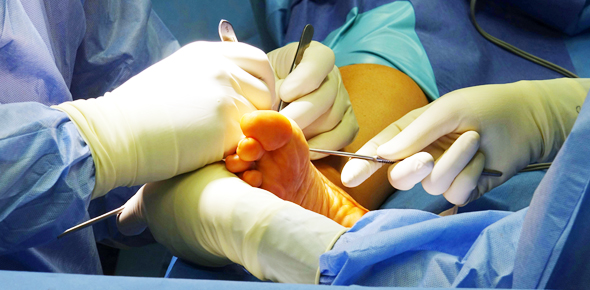
Toe pain can significantly affect balance, gait, and overall mobility, even when discomfort seems mild at first. The toes play a fundamental role in stability and push-off during walking and running. According to the American Orthopaedic Foot & Ankle Society (AOFAS), pain in the toes often reflects underlying biomechanical issues, joint degeneration, soft tissue irritation, or nerve involvement rather than an isolated surface problem. Because toes absorb and transfer forces with every step, even small abnormalities can lead to persistent discomfort over time.

DPM, FACFAS, FACFO
Over 30 years of experience in podiatric surgery, medical education, and clinical leadership

DPM
More than a decade of caring for patients across Connecticut as a board-certified podiatric surgeon

DPM
Up-to-date surgical training with a conservative-first approach, guided by current research

DPM
An exercise science specialist who combines advanced surgical training with genuine empathy
Understanding Toe Pain and Its Impact on Daily Life
Dr. James M. DeJesus frequently notes that toe pain is underestimated by many patients. When left unaddressed, it can subtly alter walking patterns, increasing stress on the midfoot, ankle, and knee, which may contribute to broader musculoskeletal issues.
Common Causes of Toe Pain
Toe pain can arise from a wide range of conditions, including structural deformities, overuse injuries, and inflammatory or degenerative joint changes. Common causes include bunions, hammertoes, arthritis, tendon irritation, nerve compression, and repetitive pressure from ill-fitting footwear. The AAOP highlights that abnormal toe alignment and limited joint mobility often increase focal pressure during gait, leading to pain that gradually worsens with activity.
Trauma, even minor repetitive trauma, can also play a role. Dr. Austin Davidow explains that athletes and individuals with physically demanding jobs may develop toe pain due to repetitive loading, sudden changes in activity level, or insufficient recovery time, even without a single memorable injury.
Symptoms and Functional Limitations
Toe pain may present as aching, sharp pain, stiffness, swelling, burning sensations, or reduced range of motion. Some patients experience discomfort mainly during walking or standing, while others notice pain at rest or at night, which may suggest nerve involvement. According to AOFAS guidance, persistent toe pain that interferes with footwear tolerance, balance, or daily activities warrants professional evaluation.
Dr. Michelle DeJesus emphasizes that pain in the toes can significantly reduce push-off strength during walking. This loss of efficiency often leads patients to compensate by shifting weight to other parts of the foot, increasing the risk of secondary problems such as forefoot pain or arch strain.
How Toe Pain Is Evaluated
A thorough evaluation begins with a detailed medical history and physical examination focused on toe alignment, joint mobility, skin condition, and areas of tenderness. Weight-bearing assessment is essential, as many toe deformities and joint issues become more pronounced when standing or walking. According to the AOFAS, imaging such as X-rays may be used to assess joint space narrowing, bone alignment, or arthritic changes when clinically indicated.Footwear assessment and gait analysis are also key components of diagnosis. Dr. Betty Carreira notes that understanding how shoes interact with toe structure is critical, as chronic pressure or limited toe box space can both cause and exacerbate pain.
Treatment Approaches and Long-Term Management
Treatment for toe pain typically starts with conservative measures aimed at reducing pressure, improving alignment, and restoring normal function. AAOP-supported strategies may include footwear modifications, activity adjustments, orthotic devices, targeted stretching and strengthening exercises, and strategies to offload painful areas. These approaches aim to address the root cause rather than masking symptoms.
When conservative care does not provide sufficient relief, additional interventions may be considered based on the specific diagnosis. Dr. James M. DeJesus stresses that treatment decisions are individualized, focusing on long-term joint health, functional improvement, and preventing progression of deformity or degeneration.
Risks of Leaving Toe Pain Untreated
Ignoring toe pain can allow deformities, inflammation, or joint damage to progress. The AOFAS notes that untreated toe conditions may lead to worsening alignment, increased stiffness, chronic pain, and reduced activity tolerance. Over time, this can limit mobility and negatively impact quality of life.Dr. Austin Davidow highlights that early evaluation often leads to simpler treatment options and better outcomes, reducing the likelihood of long-term complications that may require more invasive care.
Your Plan for an Active Life
1. Schedule an Expert Evaluation Built Around You
We examine the structure of your foot, your gait mechanics, X-ray findings, and your symptoms to understand the root cause—not just the bump on the side of the toe. Your doctor will explain which type of bunion surgery best fits your goals.
2. A Clear, Personalized Treatment Plan
Whether you need a minimally invasive bunionectomy, an osteotomy, or a Lapidus fusion, your surgeon will walk you through the reasoning behind the recommendation and what outcomes you can expect.
3. A Roadmap Back to Comfortable Movement
Recovery includes guided weight-bearing progression, protection of the surgical site, and rehabilitation to restore mobility and strength. We make sure you know every step before surgery begins.
Why Trust Family FootCare with my Toe Pain?
Patients choose us because of our advanced training, evidence-based decision-making, and a patient-centered approach that makes each person feel understood and supported. Our CT podiatric doctors bring extensive experience in surgical reconstruction and use modern diagnostic tools to ensure precise evaluation. We don’t rush decisions: every patient receives a thorough explanation of findings, treatment options, and realistic expectations so they can make informed, confident choices about their care.
Related Conditions and Treatments
Toe pain is often associated with bunions, hammertoes, arthritis of the foot, nerve conditions, forefoot pain, and nail or soft tissue disorders. Addressing these related issues as part of a comprehensive approach helps restore comfort and functional movement more effectively.
We provide a full spectrum of treatments tailored to the diverse lifestyles of Danbury, Southbury, and Naugatuck, CT residents.
Schedule Your Appointment Today
If toe pain is limiting your life, you don’t have to keep pushing through it. Our team will help you understand the cause of your symptoms and whether surgical correction may offer long-term relief. Schedule a consultation to begin your path toward comfortable, confident movement.
Whether you need a routine diabetic foot check, orthotics for work, or treatment for an injury, Family Footcare CT is here to help. Contact us!
Call us today to book your visit:
📞 +1 203-405-6501
Frequently Asked Questions (FAQ)
Big toe pain is often arthritis (Hallux Rigidus) or Gout. Ice and stiff-soled shoes help limit motion. If the joint is red and hot, see Dr. Betty M. Carreira to rule out infection or gout.
Shooting or burning pain often indicates a Neuroma (pinched nerve) or neuropathy. If squeezing the ball of your foot reproduces the click or pain, you likely have a Morton’s Neuroma. We offer injection therapy in Danbury to resolve this.
Yes. A large bunion can press on the sensory nerve running along the toe, causing numbness. Correcting the bunion surgically with Dr. DeJesus often relieves this nerve compression.
Turf toe is a sprain of the big toe joint, common in athletes playing on artificial surfaces. It requires strict immobilization to heal. If not treated, it leads to rapid arthritis.
This is a “crossover toe,” usually caused by a plantar plate tear (ligament rupture). It is a progressive deformity. Dr. Austin Davidow specializes in repairing the plantar plate to straighten the toe before it becomes permanent.
If you drop a heavy object on your toe, subungual hematoma (blood under the nail) can build painful pressure. We can painlessly drain this blood (trephination) in the office to provide instant relief.
Corns are caused by bone rubbing against the shoe (often from a hammertoe). “Corn pads” only treat the symptom. We treat the root cause—the bony deformity—often with a simple, minimally invasive procedure to straighten the toe.
Most toe surgeries (hammertoe correction, nail surgery) allow for immediate weight-bearing in a surgical shoe. You won’t be bedridden. We focus on keeping our Southbury patients mobile.
This is Raynaud’s Phenomenon, a vascular condition where blood vessels spasm in the cold. It requires keeping feet warm. If it happens in warm weather, it could be a circulation blockage requiring vascular testing (ABI).
Yes. Brachymetatarsia (short toe) or long toes can be surgically corrected for cosmetic and functional reasons. We ensure the toes are aligned parabolically for a proper fit in shoes.